
It’s 3am. You’re lying in bed, wrapped up like a burrito in your blanket, nice and safe and warm. But your heart is thumping, your breathing is shallow, you’re sweating. What’s going on? Why do I feel like I’m about to pass out? Why do I feel like this? I’m not in danger. There’s nothing here that can hurt me.
Let’s take a step back. What you’re feeling is your body’s attempt to manage modern life using the tools it has that date back thousands of years. Back when your only concerns were finding enough food to eat while not being eaten by a sabertooth tiger. Fight or flight, kill or be killed, was very real back then. Now that your biggest worries are making sure your bills are paid, or maybe having to face down an HR person for saying things that are “looked down upon”, maybe those drastic measures aren’t strictly necessary. But guess what? That’s all of the tools at your disposal.
To make it easier to understand, and to save me some typing, I’m going to refer to the two major actors in your brain as caricatures. If they come off as too childish, just roll with it. I’d rather be too simplistic than too technical.
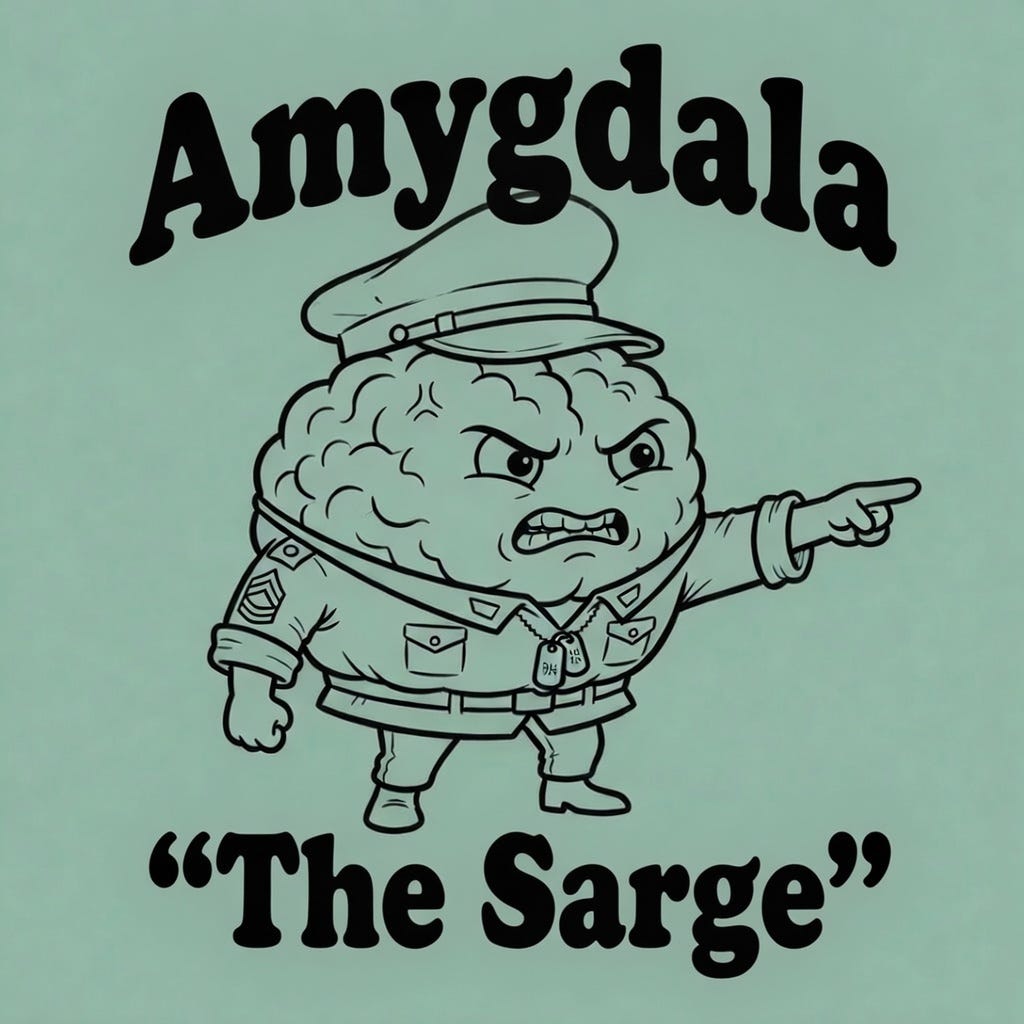
The first one I like to call Sarge. Sarge represents your amygdala. That’s the part of your brain responsible for detecting threats and sounding the alarm. Sarge has been around, in one form or another, since the first animal brain. He is fast, loyal, and absolutely convinced that the slightly passive-aggressive email from your boss is the same level of emergency as a predator in the dark. He doesn’t distinguish. That’s not his job. His job is to keep you alive, and he takes it very seriously.
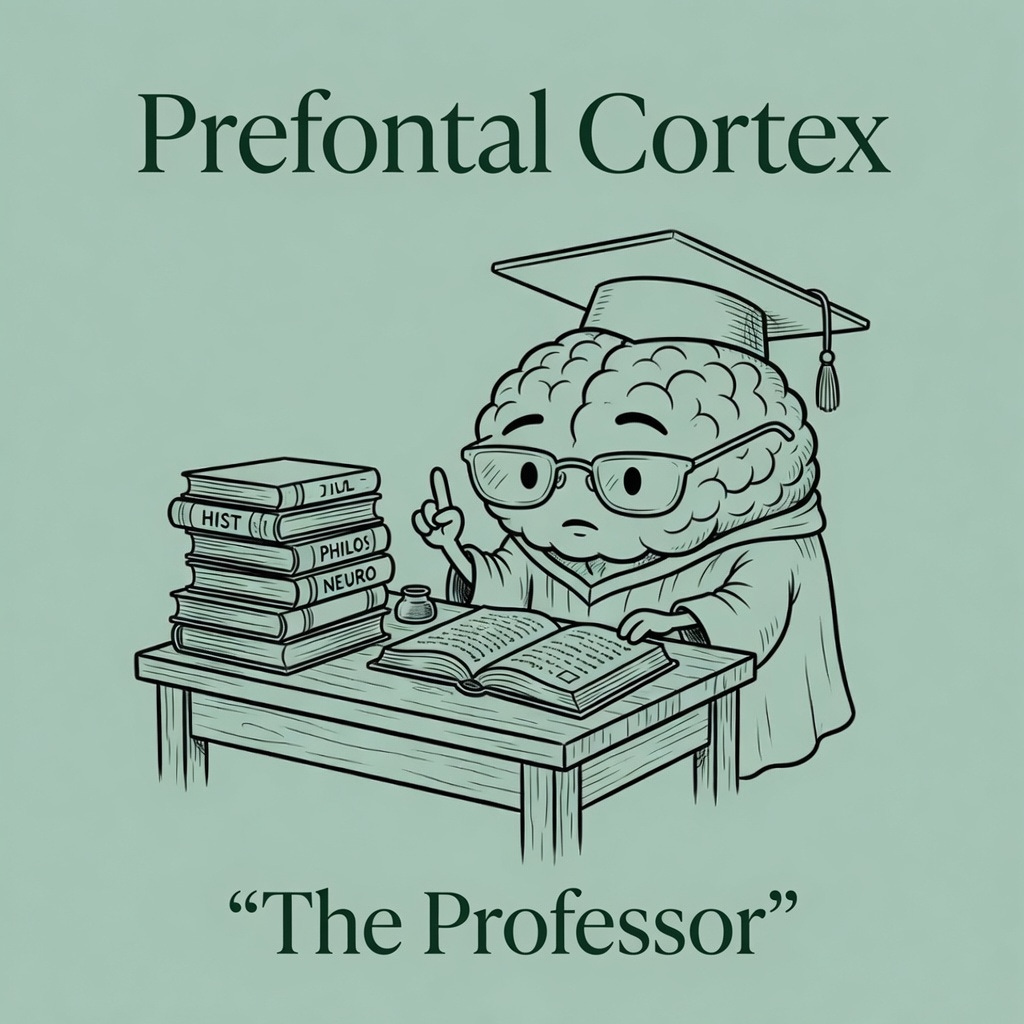
The second is The Professor. He represents your prefrontal cortex, the rational, thinking, “let’s just take a moment here” part of your brain. The Professor is measured. Considered. Patient.
Now here’s the problem. When Sarge fires, The Professor goes *partially offline*. Not as a metaphor. Physiologically. Your body is wired so that in an emergency, you don’t write a pros-and-cons list. You run. Or fight. The thinking brain steps aside so the reacting brain can do its thing.
This works great against actual predators. Not so great against HR.
When Sarge yells, your body jumps. Heart rate goes up. Blood pressure goes up. Cortisol goes up. And digestion stops. Your body decides that hot dog you just ate isn’t a priority. I know, right? With chili, onions and mustard. What does the body know? Anyway, The Professor, like we said, goes partially offline.
All of this is a great design for a short-term emergency. Run, fight, survive, recover. The whole system is built to sprint, not jog.
Here’s the problem. Sarge was never designed for modern life.
The threats we face today don’t resolve in five minutes. The passive-aggressive email doesn’t go away when you run from it. The unpaid bill is still there in the morning. The difficult conversation keeps getting postponed. And every time Sarge reads these situations as emergencies, which he does, because that’s all he knows how to do, your body pays for it.
Chronic stress, which is just Sarge refusing to stand down, comes at a cost. Elevated cortisol over time damages the hippocampus, the part of the brain responsible for memory and context. It weakens The Professor’s ability to regulate Sarge. It drives chronic inflammation, which is linked to cardiovascular disease and a measurably shorter life expectancy, and I don’t mean that loosely. That’s an actual medical finding.
And that’s before we get to the psychological toll. You can’t sleep, your relationships are strained, and you just become numb to it, which makes it even worse, because now you’re not doing anything to course correct.
Here’s the part that took me the longest to figure out. The monster is real. I mean, the heart pounding, the feeling of impending doom, the sleepless nights. But then again, it’s not real. Just the results, or the reaction you experience. That’s real.
But the threat? The thing that set Sarge off?
Not real. At least, not real in the sense that you’re going to be eaten by a sabertooth tiger anytime soon.
That’s the difference between fear and anxiety. The sabertooth tiger about to eat you, that’s fear. The letter you got that tells you to report to HR tomorrow morning, that’s anxiety. It’s like fear without the object to be afraid of. You might get yelled at, but you aren’t going to be digested.
So the cruel part is that your body doesn’t really differentiate between something you need to fear and something that just gives you anxiety. Sarge thinks they’re the same, so he ramps up your body to DEFCON 1.
The monster is real. And entirely made up. Both things are true at the same time.
Okay, great, so now what? Well, there is something you can do. It’s about training your brain. You can rewire, relearn. You can change your brain so that The Professor is stronger and remains in charge longer, especially when it can be. And Sarge learns to relax, take a chill pill and see if it’s really necessary to pull the pin on the grenade. There’s a tool you can use, and next time, we’re going to talk about the people who figured it out a long time ago. Before we even had the science to explain why it works.
—
R