There I was, gasping for breath, hands shaking, heart racing, needing a way to calm down, center myself, regain control. I opened my calming app, put in my AirPods and started listening. And within seconds, I was even more anxious. It’s not helping. I’m not getting calmer, I’m getting worse! What’s wrong with me. Am I unable to calm down? What am I doing wrong.
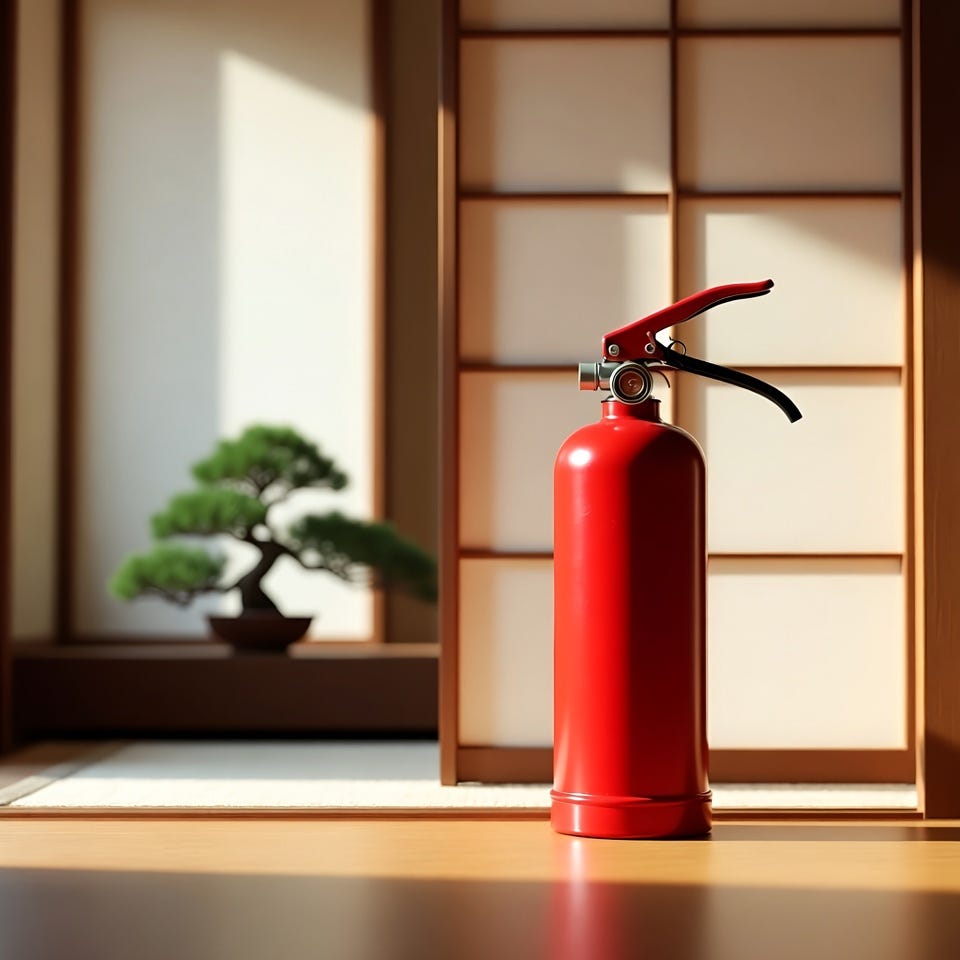
Yeah, that’s a thing a lot of people experience. You’re doing the right thing with the wrong tool. You see, as we discussed, when you’re experiencing a lot of stress, it’s like you’re fighting a fire. It’s here, it’s immediate and you need a fire extinguisher. The calming apps are teaching you a fire prevention system, not a fire extinguishing technique. Mindfulness, meditation, Zazen, body scans. Those are great when you’re not in a crisis. But they’re like trying to install a sprinkler system while your house is burning down. Wrong tool for the job.
So what are we talking about here? The “fire” is anxiety, terror, fear. Things we’ve looked at before. They’re things that cause your body to drop into the fight-or-flight state. When you’re in fight-or-flight, you’re not thinking rationally. Logically. You’re trying to survive. Your sympathetic nervous system (SNS) is running the show. Your heart rate goes up, your blood pressure goes up, your cortisol and adrenaline go up. You’ve heard this, but maybe you didn’t connect the dots. When you’re not thinking logically, you can’t begin to do a technique that requires your prefrontal cortex to participate. You need your parasympathetic nervous system (PNS) to get involved. You need a vagal brake.
Vagal brake? What’s that about? Your vagus nerve is the longest nerve in your body. It runs from your brain, through your eyes, through your neck, through your heart, your lungs and into your intestines. It sends signals to your brain telling it to calm down. You activate your vagus nerve with your fire extinguishers!
What are the fire extinguishers? Well, the quickest to do, easiest to remember and the fastest acting is the physiological sigh. This should be your first choice when you’re under a load of stress. Take a deep inhale through your nose, then another quick inhale on top of that (double inhale), then let it all out very slowly through your mouth. Do this again. By now, you should be about 80% calmer. This action activates your vagus nerve, telling it you’re okay, there’s no need for panic, let’s just calm down and talk about it. Your vagus nerve tells your brain that everything is cool. Your brain tells your body to slow your heart rate, lower your blood pressure, stop producing adrenaline and cortisol. To come back from the edge.
What do you do now that you’ve gotten some control? Now is when I go for the big daddy. The OG. The extended exhale. Breathe in for 2-4 seconds, then exhale for double that. I like to aim for 4 seconds in, 8 seconds out. When you’re panicking, you’re probably not able to take slow breaths like that (this is what the physiological sigh helps with, getting your breathing a little more manageable), so you can take shorter breaths, just make sure the exhale is longer than the inhale.
Now you can add on other techniques, like panoramic vision. Just let your vision go soft and see if you can see things in your peripheral vision. When your sympathetic nervous system is running things, you get tunnel vision because your body becomes focused on the threat. The tiger stalking you, or the ghost coming through the doorway, or your boss walking into your cubicle. Softening your focus tells your vagus nerve, “I’m not tracking a threat, so calm down”.
These are your fire extinguishers. There are more, but these are easy to do, easy to remember, and you can do them without looking like a freak. No one will be counting your breaths and say, “Gee Jim, I see you’re exhaling roughly twice as long as you’re inhaling. Are you mental?”
So when your SNS is on fire, do those. Calm yourself down. Regain control. Come back when you’re more relaxed.
Are you feeling better? Good. Had a nice meal? Slept some? Awesome. So how do we train ourselves to better handle those fires? How do we mitigate their strength? How do we make sure they happen less frequently and that we maintain better control when they happen? That’s where the sprinkler system comes in. Or even something simple, like moving gas soaked rags away from a heat source.
Let’s look at meditation. And mindfulness. And body scans. If you sit for five to ten minutes a day, doing mindfulness practices, you will change your brain. In eight weeks of doing daily meditation practice, your brain will literally re-wire itself. Your white matter will increase, which will give more time for your prefrontal cortex to tell your amygdala to dial it down. Your amygdala will actually shrink! There are studies that show this. Don’t take my word for it.
Your DMN (default mode network), the part of your brain that scientists think acts as your “self”, quiets down. When you’re busy doing things, your DMN is quiet and you don’t think about “you”. When you’re sitting in the waiting room, waiting to be called back to get weighed on the scale, and to see how high your blood pressure is, and the magazines are all women’s magazines from the 90’s, so you start thinking about “did I turn the oven off?” and “did I pay the water bill?” and your anxiety starts climbing because you’re ruminating. Keeping your DMN quiet helps to lower that background stress level that your ruminations keeps trying to turn up.
So how do you meditate? There are a lot of ways, and they all take some degree of learning. But one of the threads running through them is breathing and to stop thinking about yourself. Breathing. Here’s where the extended exhale shows up again. It’s a real two-fer. It’s not just a fire extinguisher! Wait, there’s more! If you practice extended exhale for 3-5 minutes, a few times a day, within a few weeks you will actually lower your blood pressure. There are studies. Amazing, right? And you already know how to do it! 4 seconds in, 8 seconds out. You can do it on the bus, the train, at your desk. Anywhere. Anytime.
What else? Something like Zazen (just sitting) is great for it. Thousands of years of Zen monks can’t be wrong, right? How do you do it? There are a lot of variations, but basically, you sit on the floor, cross legged, and gaze softly at the floor. Set a timer, or use one of the ones I have on my YouTube page, and just sit. Thoughts will arise, just notice them and let them go. Don’t actively try to chase them away, that will lead to more. Your thoughts are going to be like ripples on a pond. At first, there’s a lot of waves, but over time, your mind pond will settle to a glassy surface. Need help? Count your breaths. One, two, three. Count to ten. Once you get to ten, start over with one. Lose count? Start over. Get distracted? Start over.
There are others, and I’ll cover them more explicitly in the future. For now, just know that they are there. And that they take time. These aren’t instant fixes. These take practice and time. Weeks. But they work. The effects are there and you will notice them down the road. You will be more calm, more peaceful and react more thoughtfully.
Still want proof? Okay, your HRV (heart rate variability) is a measure of your body’s ability to handle stress. It’s a measure of your sympathetic nervous system compared to your parasympathetic nervous system. Your Apple Watch already records it in your Health app. Check under the Browse option and you’ll see it under Heart. Other devices will track it for you, too. There are recommended ranges you should be in based on your age, so the older you are, the lower your range, the lower your stress handling capabilities. I think that’s because of the kids. They don’t just give you gray hairs. So, your HRV. Check it now. See what it is and don’t worry about remembering it, Apple Health app will track it for you.
Resonance breathing. This is a fire prevention system and you can do it daily. It’s super easy, especially with a breath prompt that will tell you when to inhale and when to exhale. You want to aim for 5.5 seconds in, 5.5 seconds out. That’s about 6 breaths per minute. Which is resonant with your cardiovascular frequency. Your resting heart rate *should* be around 60 to 70 beats per minute, depending on your fitness level. So your breathing is coherent with your heartbeat. Do resonance breathing (also called Coherent breathing) for five minutes a day and check your HRV. You probably won’t notice anything for a week or two, but it should start going up, indicating your stress tolerance has increased. From breathing. For five minutes a day.
Fire prevention systems take a while to install and train, but they get there. And they minimize your fire possibility and magnitude. Fire extinguishers get the fires knocked down quickly so you can function. Each has a purpose and a time for its use. A lot of people tell you *how* to sit Zazen, or how to do a body scan. But they don’t tell you that you need to be rational to use them. They don’t tell you that you can’t install a sprinkler system if the kitchen is burning, or that removing those gas soaked rags doesn’t work when they’re on fire. I mean, maybe it does, but it’ll probably burn you in the process. It’s better to just spray some CO2 on it and deal with it when it cools off.
They always say that when you only have a hammer, everything looks like a nail. And when you only know how to do a body scan, well, you’re not going to be able to get your nervous system to a place where you can do that body scan. The right tool for the right job. And having the tools is one thing, but knowing why one tool won’t work and why another will is what empowers you to make the right choice in managing your stress.
Slow down. Be quiet.
—R