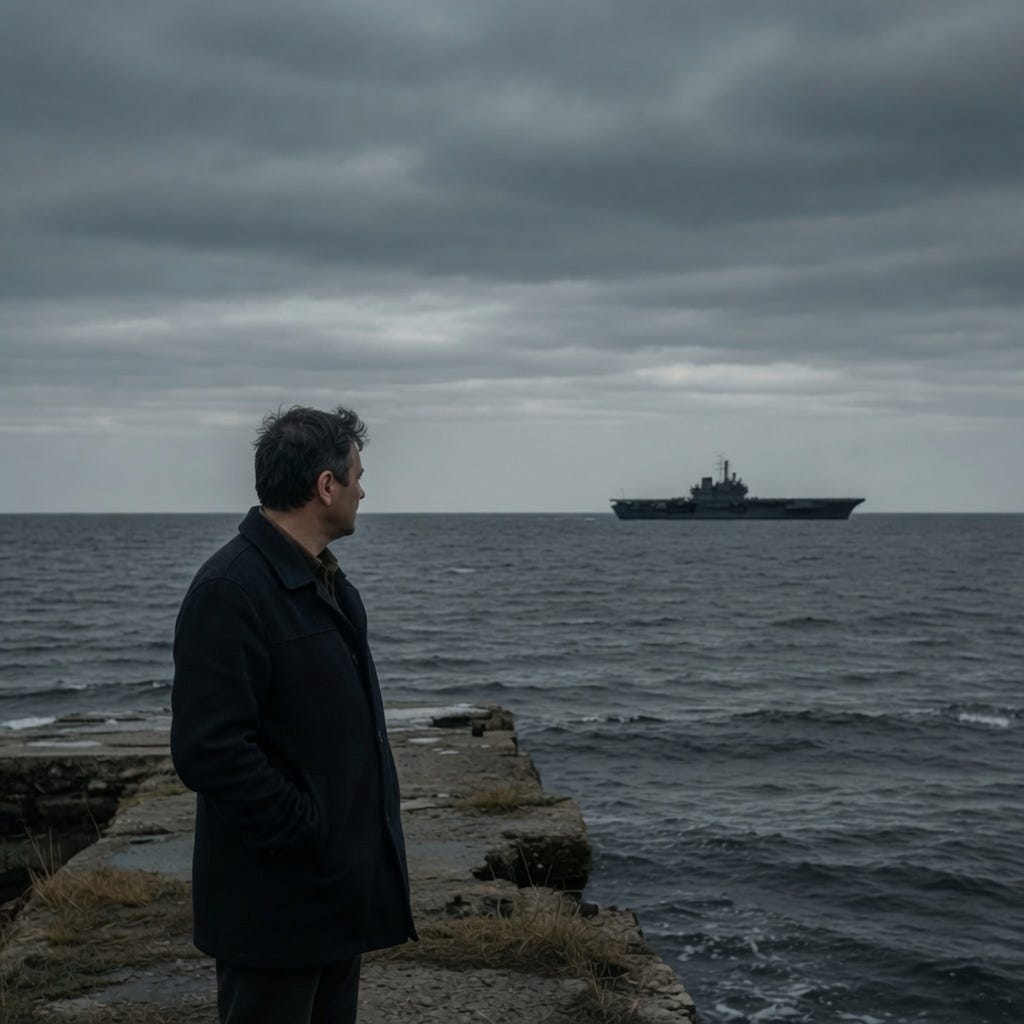
The day was gray. I mean, mentally, physically, meteorologically. It was gray. Cold and gray, cloudy, windy, and off in the distance, across the gray water slid the gray behemoth making its way out of Hampton Roads, and out of my life, carrying with it just about everything I’d known, almost everyone I’d known, for the past few years. And there I was, standing alone, on the pier, with my freedom, my possibilities and my loneliness. It was my first day of separation from the Navy, and the first day of my ex-ship’s next cruise. All the guys I’d spent the last few years with, my brothers, my family, my identity, sailing off into the gray.
Separation, if you’re not familiar with military life, is a bittersweet moment. You’re now at the whim of your own personal choices. You can sleep in. You can take the day off. You can choose to not go out to see for months at a time. You can make plans for more than a week in the future. I mean, it’s up to you. You can decide that the second weekend of the month, six months from now, that yes, you absolutely can go to the beach. And with that freedom comes the isolation. The loss of that support group. That loss of the only people who really get your sense of humor. Or understand why you feel the way you feel, or why you do the things you do, or why you say the things you say. And it’s a real loss because as a military member, you’re probably not *from here*. You’re probably from wherever you call home. Wherever your family is. Your real, biological family, or whatever passes for it. You’re from Ohio (probably). Or Texas. Or California. You’re not from Virginia, and if you are from Virginia, you’re probably not from Hampton Roads. Norfolk.
So when you get back to where you’re from, all those guys, and gals, won’t be there. And back when I separated, there weren’t the connections like today. So at least those getting out today have that going for them. But distance is time, and time adds to the distance and closeness slips away. And they’re going out tomorrow for a two week cruise, so they won’t be able to talk to you. And they’re still living in the structured, “everything is already planned for you” world, so they won’t know how to help you manage your new life.
So you struggle with a lot of things you didn’t expect to struggle with. And on top of the loss of community, support and mission, you also have a psychological weight to carry. Boot camp did a lot for us. It taught us to become, nearly, completely dependent on our command structure to structure our lives. To tell us when to eat, when to sleep, what to wear, how to fold what we’re going to wear, how to stow what we just folded. We’re told almost everything we need to do. And we’re trained. We’re giving a very special ability that isn’t really even spelled out. We’re given stress inoculation. Whoah, what’s that? Is that what was in those airguns they shot into our arms? No, that was regular inoculations. But the parallel is there. Viral inoculations are a low dose of something potentially very bad given to us in a way that our body builds up the ability to handle it. That’s what those shots did for viruses. Stress inoculation works similarly. We’re giving stressful situations and taught to act under pressure. We need that ability to enter a combat arena and not shut down. To be able to fix that leaking bulkhead. Or get that reactor back online. Or duck down in the foxhole. I guess. That’s more of an Army thing.
Stress Inoculation Training (SIT) was developed as a way to get you prepared to be able to act in a stressful environment. Military gets it. First responders get it. A close analog is called stress resistance, and it’s what comes naturally for people who live in stressful environments. People who grew up with domestic violence, or things we tend to not talk about. But with SIT, you’re taught it in an environment where you know the Navy has your back, when it comes down to it. And the stress ends. With stress resistance, it doesn’t end, you know it’s always there.
SIT comes from a training program Donald Meichenbaum created in 1985. It had three phases. The first phase teaches you what stress is and how it works. Phase two shows you how to come back from the stress. Phase three exposes you to stress gradually so you build up a tolerance. Phase one and three helped us fulfill our role. Phase two wasn’t necessary to the mission, so it was skipped in boot camp.
That’s the return we need physiologically. We need to know how to recover. Here’s something. Only around 12% of veterans get mental health service. Why? Self-reliance. Where did that come from? We were taught that in the service. First responders, you’re not off the hook. 33% of first responders say there’s a stigma attached to getting help and 90% say that stigma is career impacting. So whether it’s from a taught sense of self-reliance or fear of damaging a career, we don’t get help.
So what can we do? I’m looking for ways to help us make ourselves better on our own. Let’s be self-reliant, if that’s who we are, and do it ourselves. Let’s make it our mission to get the skills to recover.
Here’s a couple of quick things I’m trying and I’ve already seen some benefit. Let’s continue getting stress resilient.
First, in the morning, before you get your day going, do some resonance breathing. It’s easy and free and directly raises your HRV (heart rate variability), which is a measure of how resilient to stress you are. So the breathing is simple. Breathe in for 5.5 seconds, then breathe out for 5.5 seconds. Do that for 5 minutes. You should be at a rhythm of around 6 breaths per minute, which synchronizes with your cardiovascular rhythm of around 0.1hz. The Catholic rosary, Hindu pranayama and Zen chanting are all at about the same rhythm. It’s been around for a long time and now science has shown why it works. And you can do it anywhere, with no equipment, and for free.
Second, also in the morning, when you’re at the end of your nice hot shower, turn the water as cold as it gets. And stand there for at least 20 seconds. Your norepinephrine spikes, your brown fat activates, and you’re practicing tolerating acute discomfort. This is training. You’re training your body that it can recover from uncomfortable (stressful) situations. You’re conditioning your nervous system’s recovery response. And after a week or so of doing this, it won’t be so bad and you can stay longer. You want to aim for about 3-4 sessions per week for a total of about 11 minutes. 20 seconds of exposure, then dry off and let your body warm up on its own.
What about the separation? How do you work with that? Community. Find veterans, or first responders, or a knitting circle, or a book club. Find a group of people that can share your interests and show you support. Veterans finding veterans and first responders finding first responders helps on an additional level because you’ve got shared experiences and have that automatic trust built in. So what is it about community that works? Aside from finding people to network with for finding jobs, or learning how to make a dental appointment, you get some physiological benefits. You get co-regulation. When you’re around someone who has a well regulated nervous system, your nervous system will pick up on it and follow their lead. Being around someone with your shared experiences adds the trust multiplier, which lowers your autonomic cost because you don’t have to work as hard to assess safety. Which makes co-regulation even more efficient. That social contact also releases oxytocin, which lowers your cortisol. That lowers your stress load. You know why the military made us march together, eat meals together, suffer together? Yup.
Peer support works. Veteran peer support programs show measurable outcomes. They reduce PTSD symptom severity, improve the likelihood you’re going to get help.
We were trained to operate inside a system and nobody taught us how to recover. The physiological return and the social return. Both are similar shapes. They taught us how to get in, but not how to get out. Stress Inoculation Training skipped phase 2, we didn’t teach our nervous systems how to get back. Practice fills that gap. You can do it yourself, at home, in private, for cheap. Civilian life removed our unit, our structure and our mission. Social organizations can help restore all three.
The return is a skill. At two levels. Physiologically and socially. We weren’t taught how to return, but we can learn it.
— R